Kratky lettuce is genuinely one of the easiest things you can grow hydroponically. If you are specifically looking for how to grow miner's lettuce, the Kratky principles and setup are the same, but you can adjust timing and light to match its different growth habit. You fill a container with nutrient solution, suspend a net pot over it so the roots hang down toward the water, and then just let the plant drink.
How to Grow Kratky Lettuce: Step-by-Step Indoor Guide
Marcus Holloway
4 Jun 2026
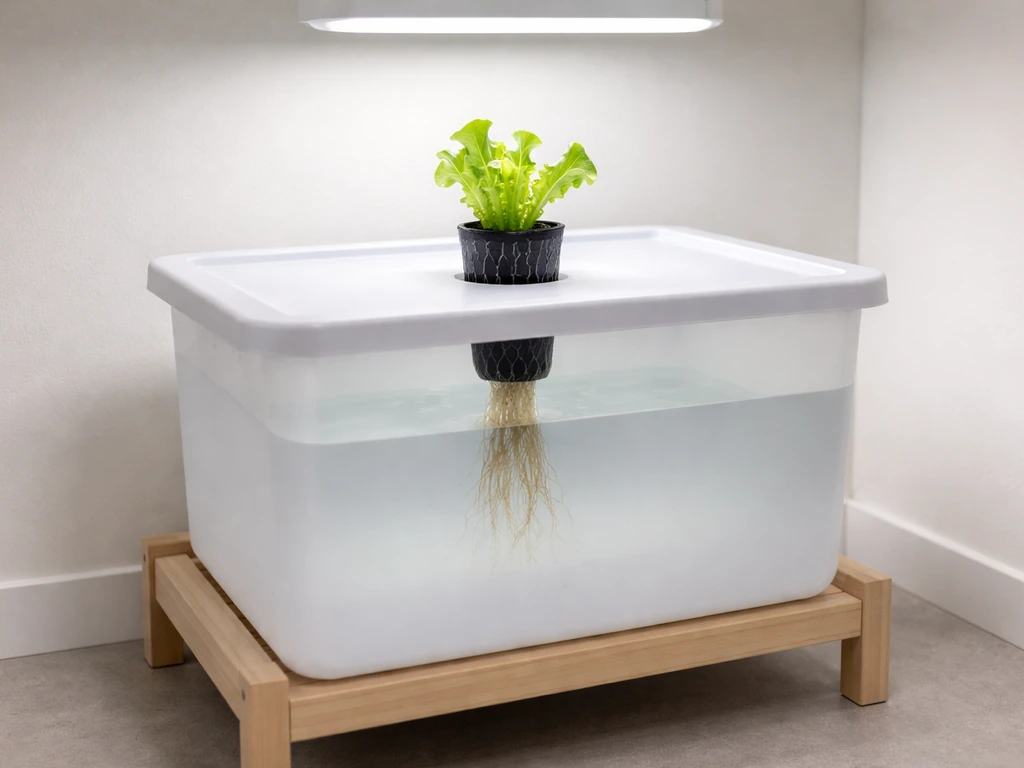
As it drinks, the water level drops and an air gap forms naturally, giving the roots oxygen without any pump or electricity. Loose-leaf varieties like Black Seeded Simpson go from transplant to harvest in about 28–38 days. Butterhead takes a bit longer at 55–70 days, and [romaine longer still](https://www. bloomingexpert.
com/garden/butterhead-vs-romaine-lettuce/). But the setup itself takes about 20 minutes, costs next to nothing, and works on a kitchen counter or under a grow light in any room.
What the Kratky method is and why it works so well for lettuce
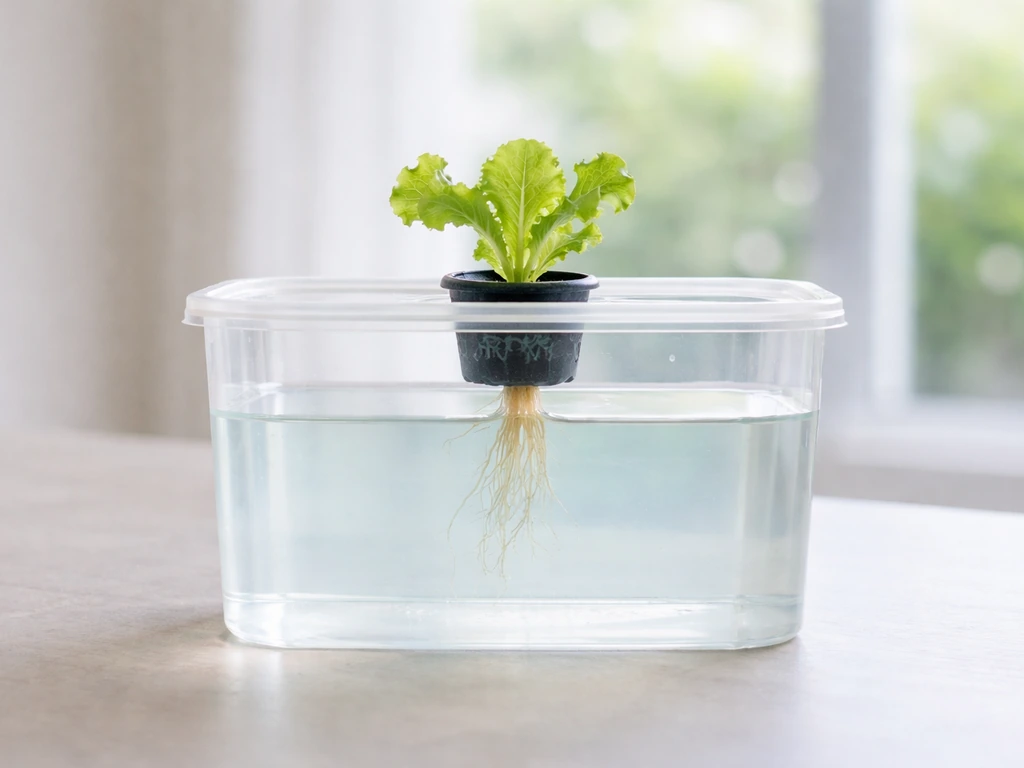
The Kratky method was developed by Bernard Kratky at the University of Hawaii as a completely passive, non-circulating hydroponic approach. There are no pumps, no air stones, no timers on water lines. You mix a nutrient solution, pour it into a sealed container, drop a net pot through a hole in the lid, and the plant does the rest.
As the roots drink the water down, an air gap forms between the bottom of the net pot and the surface of the solution. That gap is not a problem. It is the whole point. The roots that hang in that moist air space develop into what are sometimes called oxygen roots, absorbing the oxygen they need directly from the humid air inside the container.
Lettuce is almost perfectly suited to this system. It is a short-cycle crop, meaning a single reservoir fill can often last the entire grow from transplant to harvest without needing to be topped off at all for loose-leaf types. Lettuce also has a relatively modest nutrient demand compared to fruiting crops, so the passive delivery of nutrients that Kratky provides is a good match. The main thing that kills Kratky lettuce is not lack of water or nutrients. It is a collapsed air gap that suffocates the roots, or warm, stagnant water that invites root rot. Both are easy to prevent once you understand why they matter.
What you need to set up a Kratky system
Containers
Almost any opaque container works. Opacity is non-negotiable because light hitting the nutrient solution grows algae fast. Dark five-gallon buckets, black storage totes, mason jars wrapped in aluminum foil or painted black, and purpose-built Kratky reservoirs all work. For a single head of lettuce, a container holding about 1–4 liters is enough. A standard 32-ounce wide-mouth mason jar is a popular beginner choice and works fine for one plant. If you want to grow multiple plants at once, a dark lidded storage tote lets you cut several net-pot holes in the lid and run a small batch together.
Net pots and the air gap
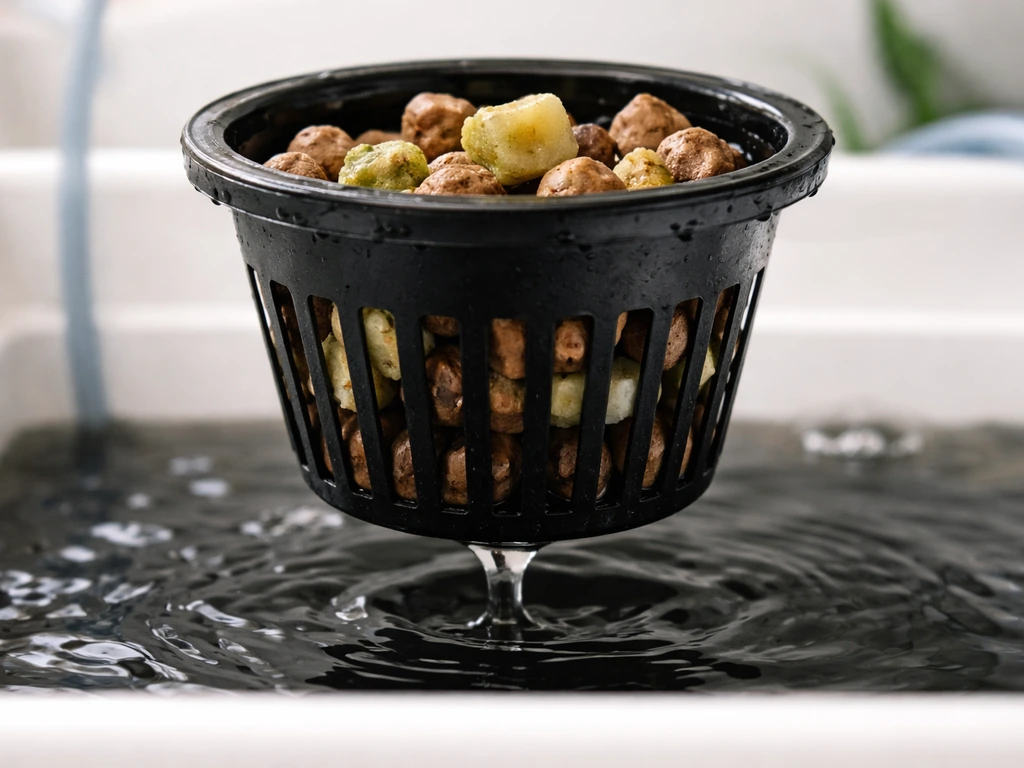
Net pots are the small mesh cups that hold your growing medium and suspend the plant over the reservoir. For full-size lettuce heads, use 3-inch net pots. For baby greens or herbs, 2-inch net pots work. The hole you cut or drill in the lid should fit the net pot snugly so it sits flush.
When you first fill the reservoir, set the water level so it is about 1–2 cm (roughly half an inch) below the bottom of the net pot. The growing medium in the pot will wick moisture up to the roots, and as the plant drinks over the following days, the water level drops and the air gap grows naturally. Never let the reservoir overflow to the point where roots are completely submerged with no air above the waterline.
That anaerobic condition is the most common cause of Kratky failure.
Growing medium
Hydroton (expanded clay pebbles) and rockwool cubes are the most commonly used media in Kratky net pots. Hydroton is reusable and drains well. Rockwool is excellent for starting seeds directly and transplanting cube-and-all into the net pot. Coco coir is another solid beginner option. Avoid regular potting soil. It compacts, clogs the net pot, and introduces unwanted biology into the reservoir.
Light
If you are growing on a sunny south-facing windowsill, you may get away with natural light, but in most indoor situations a dedicated grow light gives you far more consistent results. For lettuce, a full-spectrum LED positioned 12–24 inches above the canopy and running for 14–16 hours per day is a reliable baseline. Some growers run seedlings at 16–18 hours during the first week or two, then drop to 14 hours for the grow-out phase. Lettuce is a long-day plant, so adequate light duration keeps it in vegetative, leafy growth and delays bolting. Insufficient light is one of the main reasons Kratky lettuce turns leggy and bitter indoors.
Choosing your lettuce variety and starting plants
Not all lettuce behaves the same way in a Kratky setup, and variety choice affects how long your system runs, how much reservoir volume you need, and what kind of harvest you get. Loose-leaf types are the most beginner-friendly because they have the shortest cycle and you can harvest outer leaves continuously without pulling the whole plant. If you are specifically after red oak leaf lettuce, pick a variety suited to short harvest windows and follow the same Kratky steps for light, pH, and nutrient strength Loose-leaf types. Butterhead and romaine are worth growing but demand a longer, more stable setup. If you are just starting out, go loose-leaf first.
| Lettuce type | Days to harvest (from transplant) | Reservoir size needed | Best for Kratky beginners? |
|---|---|---|---|
| Loose-leaf (e.g., Black Seeded Simpson, Oak Leaf) | 28–38 days | 1–2 liters | Yes, best starting point |
| Butterhead / Boston Bibb | 55–70 days | 3–4 liters | Yes, slightly more patience required |
| Romaine (e.g., Paris Island Cos) | 60–75 days | 4+ liters | Manageable but longer commitment |
| Baby/cut greens mix | 21–28 days | 1 liter | Great for mason jar setups |
You can start from seed or buy seedling starts. Starting from seed is cheaper and gives you more variety options. Germinate lettuce seeds in a moistened rockwool cube or a small plug of coco coir. One important detail: lettuce seeds need light to germinate, so do not bury them.
Press the seed lightly onto the surface of the medium and keep it moist and under light. Germination happens in 2–5 days at room temperature. Once the seedling has its first set of true leaves (usually around 7–10 days after germination), it is ready to move into its permanent net pot in the Kratky reservoir. Buying seedling starts from a garden center saves time but limits variety selection and adds a small risk of introducing pests.
Nutrients and mixing: what to use and how to get it right
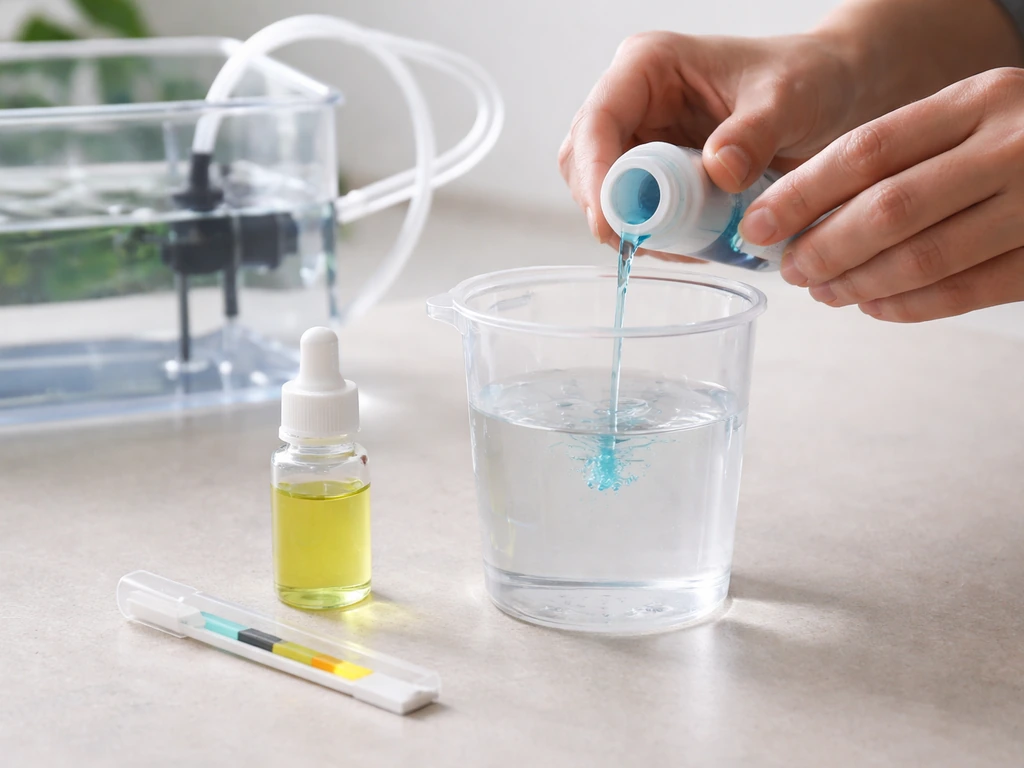
You need a hydroponic-specific nutrient solution, not standard potting fertilizer. Hydroponic nutrients are formulated to be fully soluble and to provide everything a plant needs when soil is not involved. Common beginner-friendly options include General Hydroponics Flora Series, MaxiGro, or any all-in-one hydroponic nutrient concentrate. For lettuce, a general starting point is about 1 teaspoon of nutrient concentrate per gallon of water, targeting an EC (electrical conductivity) of around 0.
UF/IFAS guidance in the AE610 resource recommends targeting about 1 teaspoon of nutrient concentrate per gallon and aiming for a total EC near 1250 µS/cm (about 1. 25 mS/cm) for Kratky lettuce [targeting an EC (electrical conductivity) of around 0. ](https://ask. ifas.
ufl. edu/publication/AE610. pdf). 8–1.
2 mS/cm for young transplants. As the plant matures, you can allow EC to rise slightly, but lettuce rarely benefits from EC above 1. 6 mS/cm and tip burn becomes more likely as EC climbs.
One thing specific to Kratky that a lot of beginners miss: because plants drink water faster than they absorb nutrients, the nutrient solution left in the reservoir actually gets more concentrated over time. If you start at 1.2–1.5 mS/cm, it may be closer to 2.0+ by the end of the cycle. For this reason, some experienced Kratky growers start at a lower EC of 0.6–0.8 mS/cm and let it rise naturally, rather than starting high and risking salt stress or tip burn mid-cycle. Both approaches work, but starting lower is safer for beginners.
pH matters more than most beginners expect. Lettuce performs best with a solution pH of 5.5–6.5, with 5.8–6.2 being the sweet spot. Outside this range, nutrients become chemically unavailable even if they are dissolved in the water. Yellow leaves with green veins (interveinal chlorosis) on new growth is a classic sign that pH has crept above 6.5 and iron is locking out. Get a basic pH meter and an EC/TDS meter. They are inexpensive and take the guesswork out of diagnosing problems. Mix your nutrients into water first, then check and adjust pH using pH Up or pH Down drops before adding the solution to your reservoir. Check pH every 3–4 days.
| Parameter | Target range | Notes |
|---|---|---|
| pH | 5.5–6.5 (ideal: 5.8–6.2) | Check every 3–4 days; adjust with pH Up/Down |
| EC (seedling) | 0.6–1.0 mS/cm | Start lower in Kratky to account for concentration effect |
| EC (mature plant) | 1.0–1.6 mS/cm | Avoid exceeding 1.8 to reduce tip burn risk |
| Water temperature | 65–72°F (18–22°C) | Warmer water holds less oxygen and raises Pythium risk |
| Air gap | 1–2 cm at start, grows naturally | Never top off to the point of flooding the air gap |
A safety note on nutrients: always add nutrients to water, never the other way around. Concentrated nutrient solutions mixed together undiluted can react and precipitate. Keep nutrient concentrates out of reach of children and rinse any skin contact immediately. Use food-safe containers if you are ever planning to eat plants grown in DIY reservoirs, and avoid using containers that previously held chemicals or cleaners.
How to set up and plant your Kratky lettuce system, step by step
- Choose and prep your container. Make sure it is completely opaque. If using a mason jar, spray paint or wrap the outside. Cut or drill a hole in the lid sized to snugly fit your net pot (2-inch for small setups, 3-inch for full-size lettuce).
- Mix your nutrient solution. Start with clean, room-temperature water. Add hydroponic nutrients at the recommended rate (roughly 1 teaspoon per gallon as a starting point). Stir well, then check and adjust pH to 5.8–6.2. Check EC and adjust if needed to land in the 0.8–1.0 mS/cm range for seedlings.
- Fill the reservoir. Pour the nutrient solution into the container, leaving enough headroom so that when the net pot sits in the lid, the water level is 1–2 cm below the bottom of the net pot. This is your starting air gap.
- Prepare the net pot and medium. Rinse expanded clay pellets until the water runs clear. Fill the net pot about halfway, nestle your rockwool seedling cube or germinated plug in the center, then fill around it with more clay pellets to stabilize. The seedling roots should be pointing downward.
- Place the net pot into the lid. Seat it snugly. If using a mason jar, screw the lid/ring on to hold everything in place.
- Position under your grow light. Set the light to 14–16 hours per day. Place the reservoir where temperatures will stay between 65–72°F. Avoid warm spots near appliances or heating vents.
- Label with the start date. Kratky is passive but not completely hands-off. Knowing when you started tells you when to expect harvest and helps you notice if growth is running behind schedule.
- Check every 3–4 days. Lift the lid slightly or look through any viewing port to see the water level. Check pH at the same time. Do not top off unless the reservoir is nearly empty and the plant still has weeks to go (see below for how to handle top-offs correctly).
The ongoing care routine and how to fix common problems
Once your Kratky lettuce is set up, the routine is genuinely minimal. Check pH every few days, watch for visible signs of stress, and keep the grow light on schedule. That is mostly it. But when something does go wrong, being able to identify it quickly saves the plant. Here is what to look for and what to do.
Slow or stunted growth
If your lettuce looks stalled, the first things to check are light duration and pH. Insufficient light (less than 12 hours, or lights too far away) is the most common cause of slow growth indoors. Move the light closer or extend the photoperiod to 14–16 hours. If pH has drifted above 6.5, nutrients become unavailable and the plant basically starves even in a full reservoir. Adjust pH down and watch for recovery within a few days. A flooded air gap, where the water level has somehow come back up to the bottom of the net pot, causes root suffocation and sluggish growth too. Check that the water line has dropped since you started.
Yellowing leaves
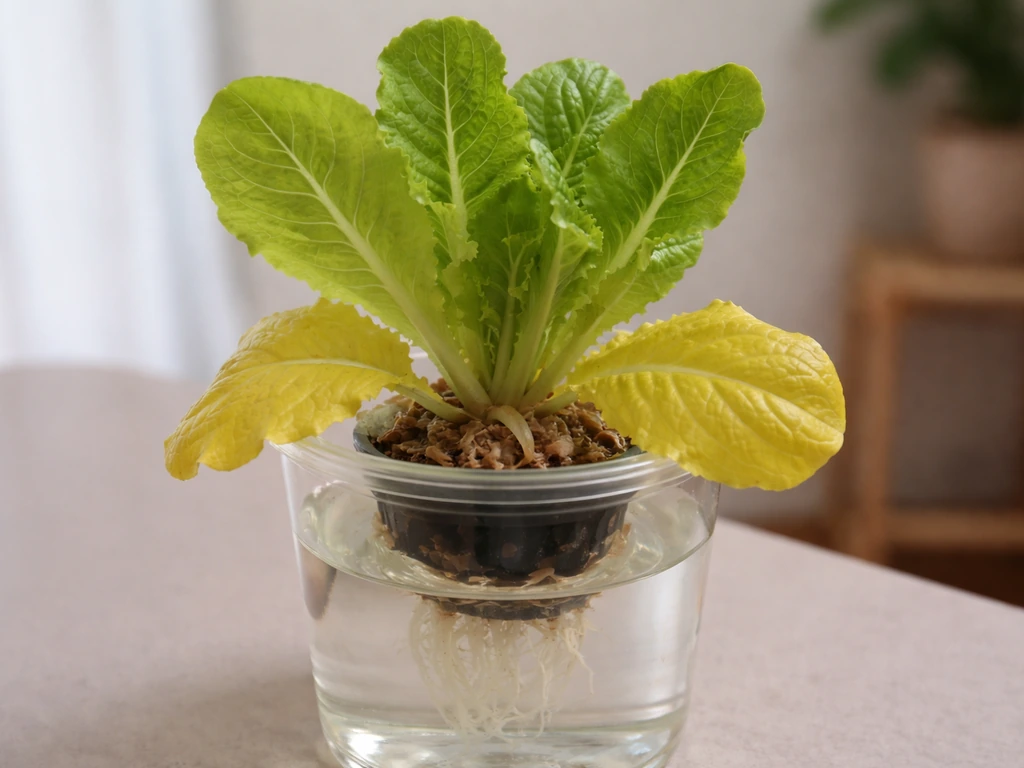
Yellow older leaves (bottom of the plant) are usually a normal part of the plant cycling nutrients upward. Yellow new growth with green veins is interveinal chlorosis, almost always a pH problem causing iron or manganese lockout. Bring pH back into the 5.8–6.2 range. Uniform pale yellowing across all leaves can indicate the nutrient solution is depleted. If the reservoir is very low and the plant has been growing for several weeks, mix a fresh batch and top off carefully without overflowing the air gap.
Tip burn and brown leaf edges
Brown, papery tips on inner leaves are tip burn, and it is extremely common in fast-growing hydroponic lettuce. It is caused by a calcium delivery problem, often triggered by high EC, low airflow around the canopy, or rapid succulent growth. It is not always a sign that anything is critically wrong, but if it is severe, check your EC and make sure it is not above 1.6 mS/cm. Adding a small fan to gently circulate air around the plants helps significantly. Tip burn tends to be worse in butterhead types than loose-leaf.
Root rot and mushy roots
Healthy Kratky roots are white or very light tan and have a slight fuzz from root hairs. If roots look brown, slimy, or smell bad, that is Pythium root rot. Warm reservoir temperatures above 72–75°F are the most common trigger. Move the reservoir somewhere cooler, or wrap it with insulating material to keep the nutrient solution below 72°F. Ensure your reservoir is fully opaque, because any light reaching the solution grows algae and feeds the conditions for Pythium. If caught early, removing the plant, rinsing the roots gently in clean pH-adjusted water, and placing it in a fresh cooler reservoir can sometimes save it. Badly affected roots usually cannot be recovered.
Bolting
Lettuce bolts (sends up a flower stalk and turns bitter) when temperatures are too warm or light exposure is too long and too intense. Indoors this is more of an issue if the setup is near a window that gets direct afternoon sun or if room temperatures regularly exceed 75°F. Choosing heat-tolerant varieties helps, and keeping the grow environment between 60–70°F delays bolting. Once a plant bolts, harvest whatever leaves are still palatable quickly because bitterness spreads fast.
Pests
Indoor Kratky setups are generally pest-resistant, but aphids and whiteflies can still hitch a ride on starts from a garden center or drift in through open windows. Check the undersides of leaves regularly. If you spot aphids, knock them off with a firm spray of water and follow up with insecticidal soap or a diluted neem oil spray. Repeat every 3–4 days until clear. Whiteflies respond to yellow sticky traps placed near the canopy.
When and how to top off the reservoir
For a typical loose-leaf lettuce cycle of 28–38 days, you often will not need to top off at all if you started with enough volume. For longer-cycle varieties like butterhead or romaine, you will likely need to add solution once or twice. When you do top off, add fresh pH-adjusted nutrient solution mixed at a lower EC than your current target (around 0.6–0.8 mS/cm), because the existing solution is already more concentrated than when you started. Add solution carefully and only enough to bring the level back up to the original starting level, never above it. Do not flood the air gap.
Harvest timing, succession planting, and keeping the lettuce coming
Loose-leaf lettuce grown in Kratky is ready to start harvesting outer leaves at around 3–4 weeks after transplant. You do not have to pull the whole plant. Harvest the outermost leaves first, leaving the central growing point intact. The plant keeps producing new growth from the center. This cut-and-come-again approach can extend your harvest period by several weeks before the plant eventually bolts or exhausts the reservoir. Full heads of butterhead or romaine are ready at 55–75 days and are harvested by cutting the whole plant at the base.
The smartest way to keep a steady supply of lettuce going is succession planting. Instead of starting all your plants at the same time and getting a flood of lettuce at once, stagger your starts every 2–3 weeks. By the time you harvest your first batch, your second batch is halfway through its cycle, and your third is just getting going. A three-tote rotation with a new one starting every three weeks gives you near-continuous harvests from a very small space. Loose-leaf varieties like Black Seeded Simpson are ideal for this because their cycle is short and predictable.
After harvesting a whole plant, rinse the container thoroughly with plain water (no soap that could leave residue), remix fresh nutrient solution, and replant. You do not need to sterilize between cycles unless you had root rot, in which case a diluted hydrogen peroxide rinse (about 3 ml of 3% H2O2 per liter of water) followed by a clean water rinse will clear any remaining Pythium spores before you reuse the container.
If you enjoy growing different greens and want to branch out from standard lettuce, the Kratky method works just as well for other leafy crops. Gourmet lettuce blends, red oak leaf, and Grand Rapids types all follow similar Kratky timelines to standard loose-leaf, making them easy substitutes or additions to a rotation without changing your setup at all. If you want a more detailed guide specific to gourmet lettuce, follow our step-by-step process for how to grow gourmet lettuce.
Your next steps today
If you want to start today, here is the shortest path. Grab a dark container, a 3-inch net pot, a bag of hydroton, a bottle of hydroponic nutrient concentrate, pH Up and pH Down, and a basic pH meter. Buy or germinate a loose-leaf lettuce seedling. Mix your nutrient solution to an EC of 0.
8–1. 0 mS/cm and a pH of 6. 0. Fill the container, seat the net pot, put it under a light for 14–16 hours a day, and check back in 30 days with scissors.
That is the whole system. Once you have a successful first grow under your belt, you can dial in specifics like EC optimization, succession schedules, and variety experiments. But the first grow teaches you more than any amount of preparation.
FAQ
How do I know my Kratky air gap is correct, especially after a few days?
Use a quick visual check: the water should sit below the bottom of the net pot by about 0.5 inch (1–2 cm) at setup, and it should stay that way or get larger as the reservoir empties. If the water rises back up near the net pot, you likely have overflow or condensation issues, and you should reduce top-off additions immediately.
Should I top off or refill if the reservoir drops a lot mid-cycle?
For loose-leaf, you often should not add anything if the container volume matches the plant count. For longer cycles, add only enough fresh, pH-adjusted nutrient solution to restore the original level you started with, using a lower EC (about 0.6–0.8 mS/cm). Do not “fill to the top,” because submerging roots collapses the air gap.
What EC and pH should I use for very small baby leaves versus bigger heads?
Baby greens tolerate a slightly gentler starting point, then you can let EC drift upward as the cycle progresses, but keep the solution pH in the 5.8 to 6.2 sweet spot. If you are seeing leaf tip edge browning or slow, pale growth, re-check pH before increasing strength, since pH drift can block nutrients even when EC looks fine.
How can I prevent algae when I am growing on a windowsill?
Even small light leaks into the reservoir can feed algae and worsen root disease risk. Make sure the container is fully opaque, cover any exposed lid gaps, and keep the reservoir away from direct sun rays. If you are using a jar, wrap it tightly so no light reaches the nutrient solution.
Is it better to start lettuce from seed or seedlings for the Kratky method?
Seed is cheaper and gives more variety choices, but you must keep seeds moist and under light since lettuce needs light to germinate (do not bury). Seedlings save time and reduce early germination steps, but garden-center starts can bring pests, so plan to inspect leaves closely right away.
What should I do if my pH won’t stay in range?
First confirm you are checking with the same meter you calibrated (or at least fresh calibration solution). Also make sure you mix nutrients into water first, then adjust pH before filling. Re-check every 3–4 days, and if pH swings are large, verify you are using hydroponic nutrients that fully dissolve rather than blended potting fertilizers.
Why are my new leaves yellow with green veins, what is the fastest fix?
That pattern usually points to iron lockout from pH being too high or too low. Bring pH back into 5.8 to 6.2, then watch for improvement on new growth within a few days. Avoid increasing EC as your first move, because high salts can worsen stress while the root is still not accessing nutrients.
My tips are brown and papery, is that always a serious problem?
Tip burn is common and does not automatically mean the whole crop will fail. If it is mild, you can manage it by reducing EC (if it is above about 1.6 mS/cm), improving gentle airflow with a small fan, and keeping growth steady rather than letting the light or temperature swing.
What conditions specifically cause Pythium root rot in Kratky lettuce?
The most common triggers are warm reservoir temperatures (often above 72 to 75°F) and light exposure to the nutrient solution. If roots turn brown or slimy and you notice bad odor, move the reservoir to a cooler spot, keep it fully opaque, and consider removing the affected plant early because late-stage recovery is usually not possible.
How do I stop lettuce from bolting when growing indoors?
Bolting is usually driven by heat plus either excessive light intensity or extended exposure periods. Keep the room and solution around 60 to 70°F when possible, avoid harsh afternoon sun near windows, and use a consistent photoperiod (14 to 16 hours is the usual baseline).
Can I grow multiple plants in one container, and how many net pots can I cut?
Yes, a dark lidded storage tote works well for a small “batch.” The key is not just number of holes, but enough reservoir volume for the longest plants you are running. If plants start nearing the end of their cycle quickly, you likely need more container volume or fewer net pots per tote.
Do I need a fan, or is still air fine for Kratky lettuce?
Still air can work, but gentle airflow often prevents tip burn and reduces the risk of microclimates that encourage rot. A small fan aimed at circulating air around the canopy (not blasting directly on leaves) is a practical upgrade, especially for butterhead types.
How should I harvest loose-leaf lettuce for the longest production window?
Cut the outer leaves first and leave the center growing point intact. This cut-and-come-again approach can extend harvest by weeks as long as the reservoir strength and oxygen conditions remain stable. Once leaf production slows or bitterness starts, harvest promptly and start the next batch via succession planning.
What is the best succession schedule for continuous lettuce harvest in a small indoor setup?
Stagger starts every 2 to 3 weeks, so at harvest time you always have younger plants coming up. For a simple rotation, many growers run three containers (or totes) and start a new batch every three weeks, which smooths out the peaks and gaps in yield.
Should I sterilize the container between cycles?
If the previous cycle was healthy, you generally only need a thorough rinse and fresh nutrient mix. If you had root rot, do a diluted hydrogen peroxide rinse (about 3 ml of 3% H2O2 per liter of water), then rinse with clean water before reusing.
Can I use DIY solutions with non-hydroponic fertilizer in a Kratky system?
It is risky. Regular fertilizers can be partially insoluble, include unwanted components, and they may not provide balanced nutrients when delivered passively. Use hydroponic-formulated nutrients to avoid precipitation and nutrient availability issues that show up as yellowing, stalling, or sudden decline.